Service-based companies often look healthy on the surface. Revenue grows. Teams are busy. Calendars are packed. Yet many owners notice their profit doesn’t follow. That is no coincidence. It is a structural issue in businesses where people produce the output. Think of marketing agencies, law firms, accounting firms, consultants, IT service companies and engineering offices.
Most of them steer on revenue and billable hours. They rarely have visibility on profitability per project, per client or per employee. As a result, a busy year can still end with disappointing profit.
This article explains how that happens. And more importantly. How to fix it.
1. The trap of revenue-driven management
Companies often celebrate revenue growth. But revenue says little about profit. A firm may sell 20 percent more than last year. Yet profit can drop because projects consumed far more hours than planned.
Service businesses fall easily into the reflex: “we need more billable hours.” That creates busyness, not profit.
2. What an hour really costs
Many owners use salary as their reference for cost price. That is inaccurate. Cost-accounting research shows the total cost of an hour is often 1.7 to 2.5 times higher than the salary number suggests.[1]
And not all hours can be billed. Internal meetings, briefings, onboarding, training, sales calls, revisions and rework consume a lot of time. Industry benchmarks show that service businesses average only 70 to 75 percent billable utilization.[2]
An employee who is 65 percent billable must generate enough margin with that 65 percent to cover 100 percent of their cost. Without insight, this remains guesswork.
3. Project profitability, the biggest blind spot
Many service firms have no clear view on which projects make money and which ones lose money. Projects are sold at a fixed price. Later it turns out they require twice the work. Clients request extras. Deadlines shift. Teams are stretched across multiple assignments. And no one sees early enough how severely the margin is eroding.
Scope creep is a well-known margin killer. Between 67 and 80 percent of agencies and project-driven companies report structural margin loss due to scope creep.[3][4]
Profit distribution is also skewed. Research shows that 20 percent of clients can generate 80 percent or more of total profit, because many others are break-even or loss-making.[5][6]
4. Not every client is profitable
Many service firms treat all clients as equally important. That sounds nice, but it is not smart business.
Structured clients with clear expectations and proper budgets tend to be profitable. Cclients with vague demands, frequent revisions and low budgets rarely are.
Customer profitability studies show the same pattern: a small group of top clients generates disproportionately high value, while loss-making clients drain margin.[7]
5. Timesheets: lots of data, little insight
Timesheets exist everywhere. But they are rarely used correctly.
Studies show timesheets contain 10 to 15 percent inaccuracy and are often filled in retroactively.[8] The biggest issue is not the input. It is the lack of analysis. In many companies, hours land in Excel. but are never linked to cost, rates or margin.
The result is plenty of data and almost no insight.
6. The KPIs that actually matter
International benchmarks confirm that profitable service businesses focus on a handful of sharp KPIs:[2][9]
- Profit margin per project
- Profit margin per client
- Profit margin per employee
- Utilization rate
- Billable realization rate
- Actual vs. planned hours
- Rework percentage
- Work in progress (WIP) and cash impact
These KPIs show where margin leaks. Not just how many hours were worked.
7. How to shift from revenue-thinking to margin-thinking
This shift requires discipline. Not complexity.
Concrete steps:
- Calculate your true hourly cost (based on time-driven costing).
- Link billing and timesheets so realization is visible.
- Perform post-calculation on every project and preferably while still ongoing.
- Classify clients based on margin, not revenue or gut feeling.
- Guard scope through clear expectations and structured reporting.
- Report daily or weekly, not monthly.
This moves the business from “we are busy” to “we are profitable.”
8. Why Excel is no longer enough
Excel works in the beginning. but fails once multiple projects, employees or clients run simultaneously.
Research shows that companies using real-time insight achieve:[10][11]
- 20 to 30 percent higher project margins
- 15 to 25 percent faster intervention on budget deviations
- better planning
- earlier detection of margin leakage
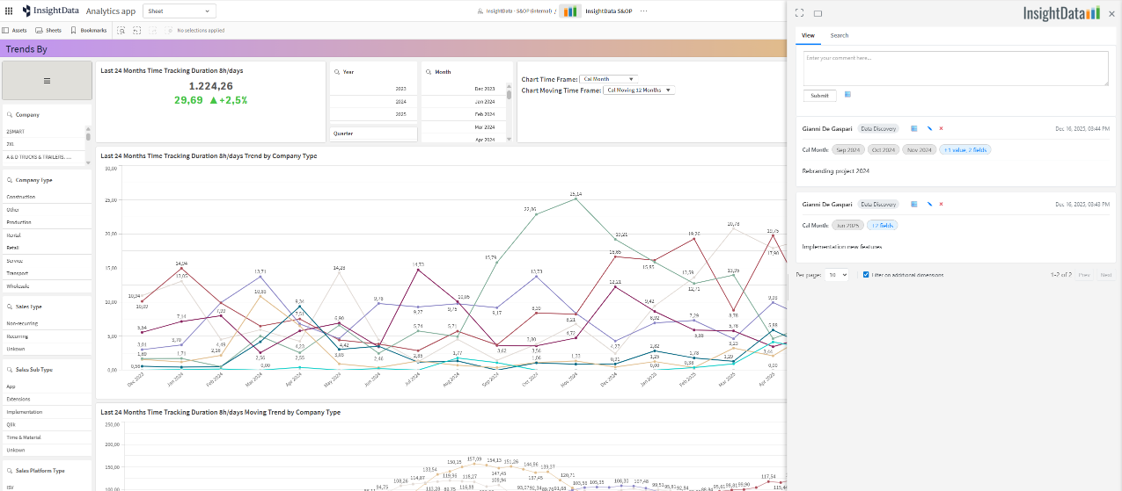
Service businesses need real-time dashboards that reveal:
- which projects are becoming unprofitable
- which clients are structurally below margin
- which employees spend too much time on internal work
- which hours cannot be billed
- how workload, WIP and margin evolve
This finally gives managers a grip on reality.
9. Conclusion
Service businesses only become truly healthy when they stop steering on revenue. And start steering on profitability. That requires insight into the real cost of time, discipline around timesheets, visibility on project margins and an honest evaluation of client profitability.
Companies that embrace this approach get more out of the same people, the same revenue and the same projects. Those that do not remain busy without moving forward.
Get in touch if you want to understand how we can help you quickly uncover the profitability of your service business.
We connect with your existing tools (including Teamleader and others) to turn your existing data into clear insights.
References
[1] Kaplan, R. & Anderson, S. (Harvard Business School). Time-Driven Activity-Based Costing.
[2] SPI Research. Professional Services Benchmark Report.
[3] Teamwork Agency Survey (2023).
[4] Wellingtone. State of Project Management Report.
[5] Bain & Company. Customer Profitability Analysis.
[6] Richard Koch. The 80/20 Principle.
[7] HBR – Gupta & Lehmann. The High Cost of Lost Customers.
[8] HBR – The Trouble with Time Sheets (2018).
[9] McKinsey – Performance Management in Professional Services.
[10] BCG – Digital Transformation in Professional Services.
[11] Gartner – BI & Analytics Adoption Report.